Friday, April 18, 2008

Definition Of Cavalry

Cavalry were soldiers or warriors who fought mounted on horseback in combat. The designation was not usually extended to any military force that used other animals, such as camels or mules. Infantry who moved on horseback but dismounted to fight on foot were in the seventeenth and early eighteenth centuries known as dragoons, a class of mounted troops which later evolved into cavalry proper while retaining their historic title.

Reenactor showing Roman military cavalry

From earliest times cavalry had the advantage of improved mobility, an "instrument which multiplied the fighting value of even the smallest forces, allowing them to outflank and avoid, to surprise and overpower, to retreat and escape according to the requirements of the moment." A man fighting from horseback also had the advantages of greater height, speed, and inertial mass over an opponent on foot.

Heavy cavalry

In modern armies, the term cavalry is often used for units that fill the traditional horse-borne light cavalry roles of scouting, screening, skirmishing and raiding. The shock role, traditionally filled by heavy cavalry, is generally filled by units with the "armored" designation.

Polish 66 Airforce Squadron of 25th Aeromobile Cavalry Brigade

Wednesday, April 16, 2008

World War 2 Heavy Tanks - Tiger I

The Tiger I was in use from late 1942 until the German surrender in 1945. It was given its "Tiger" nickname by Ferdinand Porsche . The design served as the basis for other armoured vehicles, the Sturmtiger heavy self-propelled gun and the Bergetiger amoured recovery vehicle. The initial official German designation was Panzerkampfwagen VI Ausführung H but the tank was redesignated as Panzerkampfwagen VI Ausf. E in March 1943. The tank also had the ordnance inventory designation SdKfz 181.

Tiger 1 tank at Bovington Tank Museum

The Tiger I represented a new approach that emphasised firepower and armour at the expense of mobility. Design studies for a new heavy tank had been started in the late 1930s, without any production planning. The real impetus for the Tiger was provided by the quality of the Soviet T-34. Although the general design and layout were broadly similar to the previous medium tank the Panzer IV, the Tiger weighed more than twice as much. This was due to its substantially thicker armour, the larger main gun, and the consequently greater volume of fuel and ammunition storage, larger engine, and more solidly-built transmission and suspension.

A front view of Tiger 1 on the move

The Tiger I had frontal hull armour 100 mm thick and frontal turret armour of 110 mm, as opposed to the 80 mm frontal hull and 50 mm frontal turret armour of contemporary models of the Panzer IV. It also had 80 mm thick armour on the sides and rear. The top and bottom armour was 25 mm thick; later, the turret roof was thickened to 40 mm. Armour plates were mostly flat, with interlocking construction. The armour joints were of high quality, being stepped and welded rather than riveted.

An early model parked in front of a factory

The rear of the tank held an engine room flanked by two floodable rear compartments each containing a fuel tank, radiator, and fans. The petrol (gasoline) engine was a 21-litre 12-cylinder Maybach HL 210 P45 with 650 PS (641 hp, 478 kW). Although a good engine, it was inadequate for the vehicle. From the 250th Tiger it was replaced by the uprated HL 230 P45 (23 litres) of 700 PS (690 hp, 515 kW). The engine was in V-form, with two cylinder banks at 60 degrees. An inertial starter was mounted on its right side, driven via chain gears through a port in the rear wall. The engine could be lifted out through a hatch on the hull roof.

An early model with barbed wire strung on the hull sides to prevent infantry from mounting the vehicle.

The internal layout was typical of German tanks. Forward was an open crew compartment, with the driver and radio-operator seated at the front, either side of the gearbox. Behind them the turret floor was surrounded by panels forming a continuous level surface. This helped the loader to retrieve the ammunition, which was mostly stowed above the tracks. Two men were seated in the turret; the gunner to the left of the gun, and the commander behind him. There was also a folding seat for the loader. The turret had a full circular floor and 157 cm headroom.

Tiger 1 in front of a thatched-roof farmhouse

The gun breech and firing mechanism were derived from the famous German "88" dual purpose flak gun. The 88 mm Kwk 36 L/56 gun was the variant chosen for the Tiger and was, along with the Tiger II's 88 mm Kwk 43 L/71, one of the most effective and feared tank guns of WW2. The Tiger's gun had a very flat trajectory and extremely accurate Zeiss TZF 9b sights. Tigers were reported to have knocked out enemy tanks at ranges greater than a mile (1,600 m), although most WW2 engagements were fought at much closer range.

Captured Tiger I in Tunis in 1943

The Tiger was first used in action in September 1942 near Leningrad. Under pressure from Hitler the tank was put into action months earlier than planned and many early models proved to be mechanically fragile. In its first action on 23 September 1942, many of the first Tigers broke down. Others were knocked out by dug-in Soviet anti-tank guns. One tank was captured largely intact, which gave the Soviets a chance to study the tank and prepare a response. In the Tiger's first actions in North Africa, the tank was able to dominate Allied tanks in the wide-open terrain. However, mechanical failures meant that there were rarely more than a few in action. In a replay of the Leningrad experience, at least one Tiger was knocked out by towed British six-pounder antitank guns.

Whitewashed Tigers on the march

The Tiger's armour and firepower, however, were feared by all its opponents. In tactical defence, its poor mobility was less of an issue. Whereas Panthers were the more serious threat to Allied tanks, Tigers had a bigger psychological effect on opposing crews, causing a "Tiger phobia". Allied tankers would sometimes evade rather than confront a Tiger, even a tank that only looked like one, such as the Panzer IV with turret skirts applied. In the Normandy campaign, it could take four to five Shermans to knock out a single Tiger tank by maneuvering to its weaker flank or rear armour; the Soviet T-34s fared similarly against the German tanks, as had the German PzIII earlier against the Soviet heavy tanks.

The Das Reich Tiger of SS-Oberscharfuhrer Paul Egger passing panzer grenadiers near Bykowka, Russia in July 1943 during Operation Citadel.

An accepted Allied tactic was to engage the Tiger as a group, one attracting the attention of the Tiger crew while the others attacked the sides or rear of the vehicle. Since the ammunition and fuel were stored in the sponsons, a side penetration often resulted in a kill. This was, however, a risky tactic, and often resulted in the loss of several Allied vehicles. It took a great deal of tactical skill to eliminate a Tiger.

The Tiger from the drivers side

Tuesday, April 15, 2008

Multirole Fighter - Sukhoi Su-33 "Flanker D"

The Sukhoi Su-33 (NATO reporting name 'Flanker-D') is carrier-based multi-role fighter aircraft produced by Russian firm Sukhoi beginning in 1982. It is a derivative of the Su-27 'Flanker' and was initially known as the Su-27K. The main difference from the Su-27 is that the Su-33 can operate from aircraft carriers. Unlike the Su-27, the Su-33 is capable of aerial refueling.

Su-33 on the deck of a Russian aircraft carrier

The Su-33 first flew in May 1985, and entered service in the Russian Navy in 1994. An air regiment comprising 24 fighters of the type was formed upon the Russian Navy's only operating aircraft carrier, Admiral Kuznetsov.

Forward view of an Su-33 with wings folded

The Su-33 is designed to use a ski-jump instead of catapult for carrier takeoff. The ski jump provides many advantages over a catapult launch. The most evident is that a ski jump does not put stress on the airframe and pilot, allowing lower weight because less structural reinforcement is required and prevents G-LOC (G-induced loss of consciousness.) Also, with a ski jump launch, the aircraft can engage full afterburner earlier than a catapult launch, because the aircraft is restrained by pop-up detents rather than a catapult shoe. Once in the air the aircraft has a positive AOA as well as pitch angular speed which increases during acceleration, and assists the climb. This method does require an aircraft that is more stable and maneuverable at low speeds.

An Su-33 on board Admiral Kuznetsov (Russian aircraft carrier)

The Su-33 sports canards that shorten the take-off distance and improve maneuverability, but required reshaping of the leading edge extensions. The canards counter pitch-down force generated by leading and trailing edge flaps reducing approach speed by 1.5 times; They also act as destabilizers in supersonic flight, by reducing pitch trim drag.

Su-33 preparing for takeoff

The wing area was also increased, though the span remained unchanged. The wings were fitted with power-assisted folding, and the vertical tails were shortened to allow the fighter to fit in the typically crowded hangars of an aircraft carrier. The rear radome was shortened and reshaped to allow for the tail hook, as well as to save space inside the hangars. The IRST was moved to provide better downward visibility and an L-shaped retractable refuelling probe was fitted to increase range.

One Su-33 takes off while another prepares to launch

The Su-33 carries guided missiles such as the Kh-25MP, Kh-31 and H-41. The plane can be used in both night and day operations at sea. It can operate under assistance of the command center ship, or in conjunction with a Kamov Ka-31 (a variant of the Ka-27) early-warning helicopter. The R-27EM missiles provide it the capability to intercept antiship missiles.

Su-33 showing its planform in flight

Other than air defence, the duties of the Su-33 include destruction of enemy ASW, AWACS, and transport aircraft, anti-shipping strike, support of amphibious landing, escort, reconnaissance, and laying of minefields.

Su-33 maneuvering in flight


Su-33 in flight


Overhead view of an Su-33 and an Su-25


3 view schematic

Monday, April 14, 2008

The Attack On Pearl Harbor

The attack on Pearl Harbor was a surprise attack against the United States' naval base at Pearl Harbor, Hawaii by the Japanese navy, on the morning of Sunday, December 7, 1941, resulting in the United States becoming involved in World War II. It was intended as a preventive action to remove the US Pacific Fleet as a factor in the war Japan was about to wage against Britain, the Netherlands, and the United States.

Pearl Harbor on 30 October 1941

At 03:42, Hawaiian Time, hours before commanding Admiral Chuichi Nagumo began launching strike aircraft, the minesweeper USS Condor spotted a midget submarine outside the harbor entrance and alerted destroyer USS Ward. Ward was initially unsuccessful in locating the target. Hours later, Ward fired America's first shots in the Pacific theater of WWII when she attacked and sank a midget submarine, perhaps the same one, at 06:37. Five midget submarines had been assigned to torpedo U.S. ships after the bombing started. None of these returned, and only four have since been found. Of the ten sailors aboard, nine died; the only survivor, Kazuo Sakamaki, was captured, becoming the first Japanese prisoner of war.

Aboard a Japanese carrier before the attack on Pearl Harbor, crew members cheer departing pilots.


First Wave
The first attack wave launched north of Oʻahu, commanded by Captain Mitsuo Fuchida.
  • 1st Group - targets: battleships and aircraft carriers, (50 Nakajima B5Ns armed with 800 kg armor piercing bombs, in four sections. 40 B5Ns armed with Type 91 torpedoes, also in four sections).
  • 2nd Group - targets: Ford Island and Wheeler Field, (55 Aichi D3As armed with 249 kg general purpose bombs).
  • 3rd Group - targets: aircraft at Ford Island, Hickam Field, Wheeler Field, Barber’s Point, Kaneohe, (45 A6Ms for air control and strafing. Each of the aerial waves started with the bombers and ended with the fighters to deter pursuit).
Zeroes preparing to take off from Shokaku for Pearl Harbor

Several U.S. aircraft were shot down as the first wave approached land; one at least radioed a somewhat incoherent warning. Other warnings from ships off the harbor entrance were still being processed, or awaiting confirmation, when the planes began bombing and strafing. Nevertheless, it is not clear any warnings would have had much effect even if they had been interpreted correctly and much more promptly. The air portion of the attack on Pearl Harbor began at 7:48 a.m. Hawaiian Time (3:18 a.m. December 8 Japanese Standard Time, as kept by ships of the Kido Butai), with the attack on Kaneohe. A total of 353 Japanese planes in two waves reached Oʻahu. Slow, vulnerable torpedo bombers led the first wave, exploiting the first moments of surprise to attack the most important ships present (the battleships), while dive bombers attacked U.S. air bases across Oʻahu, starting with Hickam Field, the largest, and Wheeler Field, the main U.S. Army Air Corps fighter base. The 171 planes in the second wave attacked the Air Corps' Bellows Field near Kaneohe on the windward side of the island, and Ford Island. The only air opposition came from a handful of P-36 Hawks and P-40 Warhawks.
Bombers preparing to take off

Men aboard U.S. ships awoke to the sounds of alarms, bombs exploding, and gunfire prompting bleary eyed men into dressing as they ran to General Quarters stations. (The famous message, "Air raid Pearl Harbor. This is not drill.", was sent from the headquarters of Patrol Wing Two, the first senior Hawaiian command to respond.) The defenders were very unprepared. Ammunition lockers were locked, aircraft parked wingtip to wingtip in the open to deter sabotage, guns unmanned (none of the Navy's 5"/38 AA and only a quarter of its machine guns, and only four of 31 Army batteries got in action). Despite this and low alert status, many American military personnel responded effectively during the battle.
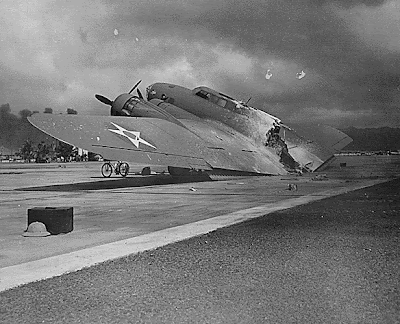
B-17 after the attack on Hickam Field


Second Wave
The second wave consisted of 54 B5Ns, 81 D3As, and 36 A6Ms, commanded by Lieutenant-Commander Shigekazu Shimazaki.
  • 1st Group - 54 B5Ns armed with 249 kg and 54 kg general purpose bombs, (27 B5Ns — aircraft and hangars on Kaneohe, Ford Island, and Barbers Point,27 B5N - hangars and aircraft on Hickam Field).
  • 2nd Group - targets: aircraft carriers and cruisers, (81 D3As armed with 249 kg general purpose bombs, in four sections).
  • 3rd Group - targets: aircraft at Ford Island, Hickham Field, Wheeler Field, Barber’s Point, Kaneohe, (36 A6Ms for defense and strafing).
USS West Virginia took two aerial bombs and seven torpedo hits; of the seven at least five were from aircraft and one from a midget submarine

The second wave was divided into three groups. One was tasked to attack Kāneʻohe, the rest Pearl Harbor proper. The separate sections arrived at the attack point almost simultaneously, from several directions. Ninety minutes after it began, the attack was over. 2,386 Americans died (55 were civilians, most killed by unexploded American anti-aircraft shells landing in civilian areas), a further 1,139 wounded. Eighteen ships were sunk, including five battleships.

A photo taken from a Japanese plane during the attack shows vulnerable American battleships

Of the American fatalities, nearly half of the total were due to the explosion of USS Arizona's forward magazine after it was hit by a modified 40 cm (16in) shell. Already damaged by a torpedo and on fire forward, Nevada attempted to exit the harbor. She was targeted by many Japanese bombers as she got under way, sustaining more hits from 113 kg bombs as she was deliberately beached to avoid blocking the harbor entrance. USS California was hit by two bombs and two torpedoes. The crew might have kept her afloat, but were ordered to abandon ship just as they were raising power for the pumps. Burning oil from Arizona and West Virginia drifted down on her, and probably made the situation look worse than it was. The disarmed target ship USS Utah was holed twice by torpedoes. USS West Virginia was hit by seven torpedoes, the seventh tearing away her rudder. USS Oklahoma was hit by four torpedoes, the last two above her belt armor, which caused her to capsize. USS Maryland was hit by two of the converted 40 cm shells, but neither caused serious damage.

USS California sinking

Although the Japanese concentrated on battleships (the largest vessels present), they did not ignore other targets. The light cruiser USS Helena was torpedoed, and the concussion from the blast capsized the neighboring minelayer USS Oglala. Two destroyers in dry dock were destroyed when bombs penetrated their fuel bunkers. The leaking fuel caught fire; flooding the dry dock in an effort to fight fire made the burning oil rise, and so the ships were burned out. The light cruiser USS Raleigh was holed by a torpedo. The light cruiser USS Honolulu was damaged but remained in service. The destroyer USS Cassin capsized, and destroyer USS Downes was heavily damaged. The repair vessel USS Vestal, moored alongside Arizona, was heavily damaged and beached. The seaplane tender USS Curtiss was also damaged. USS Shaw was badly damaged when two bombs penetrated her forward magazine.

The USS Shaw explodes during the Japanese air raid

Of the 402 American aircraft in Hawaii, 188 were destroyed and 159 damaged, 155 of them on the ground. Almost none were actually ready to take off to defend the base. Of 33 PBYs in Hawaii, 24 were destroyed, and six others damaged beyond repair. (The three on patrol returned undamaged.) Friendly fire brought down several U.S. planes on top of that, including some from an inbound flight from USS Enterprise. Japanese attacks on barracks killed additional personnel.

Hangar in Ford Island burns

Fifty-five Japanese airmen and nine submariners were killed in the action. Of Japan's 414 available planes, 29 were lost during the battle (nine in the first attack wave, 20 in the second), with another 74 damaged by antiaircraft fire from the ground.

USS Arizona sinking during the attack

Overall, nine ships of the U.S. fleet were sunk and twenty-one ships were severely damaged. Three of the twenty-one would be irreparable. The overall death toll reached 2,350, including 68 civilians, and 1,178 injured. Of the military personnel lost at Pearl Harbor, 1,177 were from the Arizona.

USS Pennsylvania, behind the wreckage of the USS Downes and USS Cassin.


USS Arizona Memorial

Sunday, April 13, 2008

Bunker

A bunker is a defensive military fortification. Bunkers are mostly below ground, compared to blockhouses which are mostly above ground. They were used extensively in World War I and World War II on a tactical level, while during the Cold War, massive bunker complexes were built to house both strategic (command & control) infrastructure as well as government personnel and stores for the event of a nuclear war.


Types


1. Trench
This type of bunker is a small concrete structure, partly dug into the ground, which is usually a part of a trench system. Such bunkers give the defending soldiers better protection than the open trench and also include top protection against aerial attack (grenades, mortar shells). They also provide shelter against the weather. The front bunker of a trench system usually includes machine guns or mortars and forms a dominant shooting post. The rear bunkers are usually used as command posts or Tactical Operations Center (TOC), for storage and as field hospitals to attend to wounded soldiers.

A trench near La Boisselle during the Battle of the Somme


2. Pillbox
Dug-in guard posts (with loopholes through which to fire guns) and made from concrete are also known as 'pillboxes'. The originally jocular name arose from their perceived similarity to the cylindrical boxes in which medical pills were once sold. They are in effect a trench firing step hardened to protect against small-arms fire and grenades and raised a little to improve the field of fire.

A WW2 pillbox on the East coast of England (the railings are a modern feature)


3. Artillery
Many artillery installations, especially for naval artillery have historically been protected by extensive bunker systems. These usually housed the crews serving the weapons, protected the ammunition against counter-battery fire, and in numerous examples also protected the guns themselves, though this was usually a trade-off reducing their fields of fire. Since artillery bunkers were often constructed for very large guns in a pre-defined location and as part of a larger system of defenses (such as for a port town or a seacoast), they are amongst the largest individual pre-Cold War bunker types found. The walls of installations like the 'Batterie Todt' in northern France were up to 3.5 m thick, with the gun inside capable of reaching over the English Channel to the opposite coast.

German bunkers at Longues-sur-Mer in France


4. Industrial
Typical industrial bunkers include mining sites, food storage areas, dumps for materials, data storage, and sometimes living quarters. They were built mainly by nations like Germany during World War II to protect important industries from aerial bombardment.

Inside the Chowder Bay Bunker